
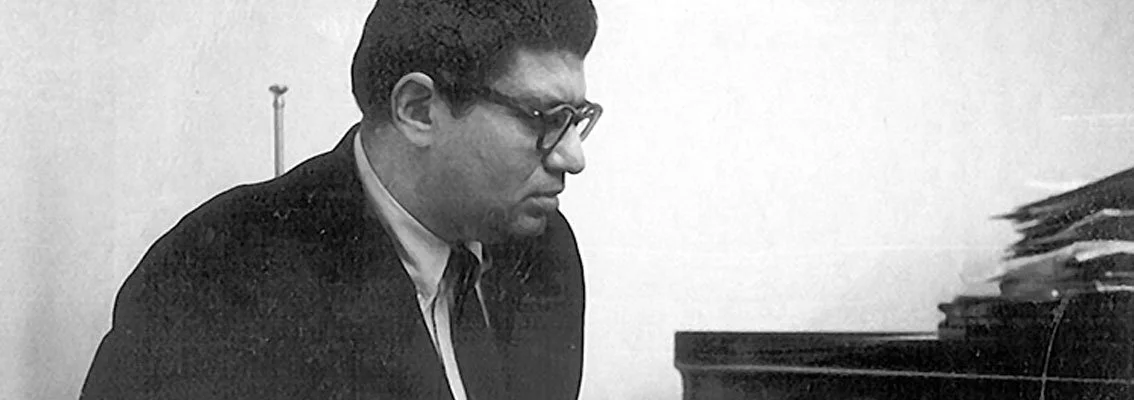
Looking Back: The Feldman In My Life
April 20-26, 2026
2026 marks 100 years since the birth of American avant-garde composer Morton Feldman, one of the true originals of American music.
Feldman’s music asks its listeners to go beyond the conventions of musical form, the familiar vocabulary of tonality, and the expectations of duration to explore the space between sound and silence, music and noise, perhaps even attention and meditation. To observe this milestone, Fear No Music presents Looking Back: The Feldman In My Life, a very special evening featuring Feldman’s rarely performed epic masterpiece Piano and String Quartet. Beginning the performance are two miniatures, Five Movements for String Quartet, Op. 5 by Anton Webern, and Feldman’s own The Viola in My Life 3.
PROGRAM
Morton Feldman - The Viola in My Life 3 (1970)
Kenji Bunch, viola
Monica Ohuchi, piano
Anton Webern - Five Movements for String Quartet, Op. 5 (1909)
Keiko Araki & Shanshan Zeng, violins
Amanda Grimm, viola
Valdine Ritchie Mishkin, cello
- pause -
Morton Feldman - Piano and String Quartet (1985)
Keiko Araki & Shanshan Zeng, violins
Amanda Grimm, viola
Valdine Ritchie Mishkin, cello
Jeff Payne, piano
PROGRAM NOTES
from artistic director Kenji Bunch
“As soft as possible”
This is the direction at the beginning of many of Morton Feldman’s compositions. At a time when rock music began to plug guitars into stacks of amplifiers, televisions and radios were installed in every home, and the bustle of postwar industrialism and technology boomed and clattered across the world, Feldman asked something different from us- something perhaps nearly impossible, but also something profoundly optimistic and essential to the human experience. He asks us to be quiet; to be still, and to listen.
Whereas postwar modernism in Europe centered around the two hubs of Paris (Pierre Boulez’s technological innovations at IRCOM) and Darmstadt (Karlheinz Stockhausen’s experimentalism), both of which drew lineage directly from Arnold Schoenberg and thus, the trajectory of the Western classical canon, the New York School of John Cage, Feldman, along with friends Earl Brown, Christian Wolff, and LaMonte Young, was both strikingly independent of this tradition, and refreshingly unencumbered with the rigorous academic stance of their European contemporaries.
With the playful Zen trickster John Cage as the ringleader, The New York School posed intriguing questions to musicians, critics, and audiences alike with bold graphic scores, extended techniques and unconventional preparations of the instruments, and spectacles that overlapped with theater and performance art. Also emerging from this maverick American answer to the European avant-garde was Morton Feldman’s unique brand of minimalism. Small, repeated cells of fragile harmony- some jarringly dissonant, others achingly beautiful; brief melodic gestures that only develop further in our own imaginations. The vast majority of it performed at a dynamic so astonishingly soft that the listener can barely discern the threshold between sound and silence.
Morton Feldman: The Viola In My Life no.3 (1970) is part of a four-part series of works for (mostly muted) viola in different instrumental contexts from chamber groups to orchestra, written for violist Karen Phillips. The third work in this series is the shortest and most intimate, at only six minutes for just viola and piano. This series represents the direction Feldman’s music would take in the later period of his life. Time becomes static rather than linear, and the notes are presented as moments floating in space as opposed to a narrative collection that lead us to a destination. In the span of just a few minutes, this radical simplicity creates a meditative, almost magical transcendence from the expectations of the concert hall.
Anton Webern: Five Pieces for String Quartet, op. 5 (1909) Feldman famously met John Cage in the lobby of Carnegie Hall in 1950 immediately following a performance by the New York Philharmonic of Anton Webern’s brief Symphony, op. 21. The concert wasn’t over- the Webern was followed by the Rachmaninov Symphonic Dances- but Cage and Feldman both agreed they couldn’t imagine listening to anything else after the Webern. Thus a lifelong friendship was born.
Nowhere is Webern’s unmistakeable voice realized more beautifully and clearly than in his miniatures for string quartet, the op. 5 Fünf Sätze, written at the age of 26, several years after he had befriended Anton Schoenberg and Alban Berg, with whom he would eventually alter the course of classical music as the Second Viennese School. Webern states in words that could have come from Feldman “harmony is expression and nothing else!” Indeed, in Webern’s freely atonal but evocative and Romantic gestures, we can hear what might have captivated Feldman and Cage on that fateful day.
Morton Feldman: Piano and String Quartet (1985) Written just two years before his death, Feldman’s 80 minute single-movement masterpiece is a shining example of his late-period writing, eclipsed in magnitude only by his 6-hour long String Quartet no. 2.
As with the Viola in My Life, the musical material is presented not as a cast of developing characters in a narrative, but as delicate fragments existing independently of each other and floating in time and space for the listener to interact with in a meditative state. Feldman once remarked in one of many offhand quips that only after about an hour into a performance is an audience truly listening. In this sense, the listener’s interface with the performance has as much to do with a personal, introspective journey as it does with the music coming from the stage. In any case, there is no other music like Feldman’s, and especially in the overwhelming sensory assault of quotidian life, perhaps no greater contrasting balm for our ears. minds, and bodies.