Looking Inward, Spacing Out
February 20-22, 2026
Looking Inward, Spacing Out invites us to listen across time and space—toward the past that shapes us, the present we share, and the future we imagine together.
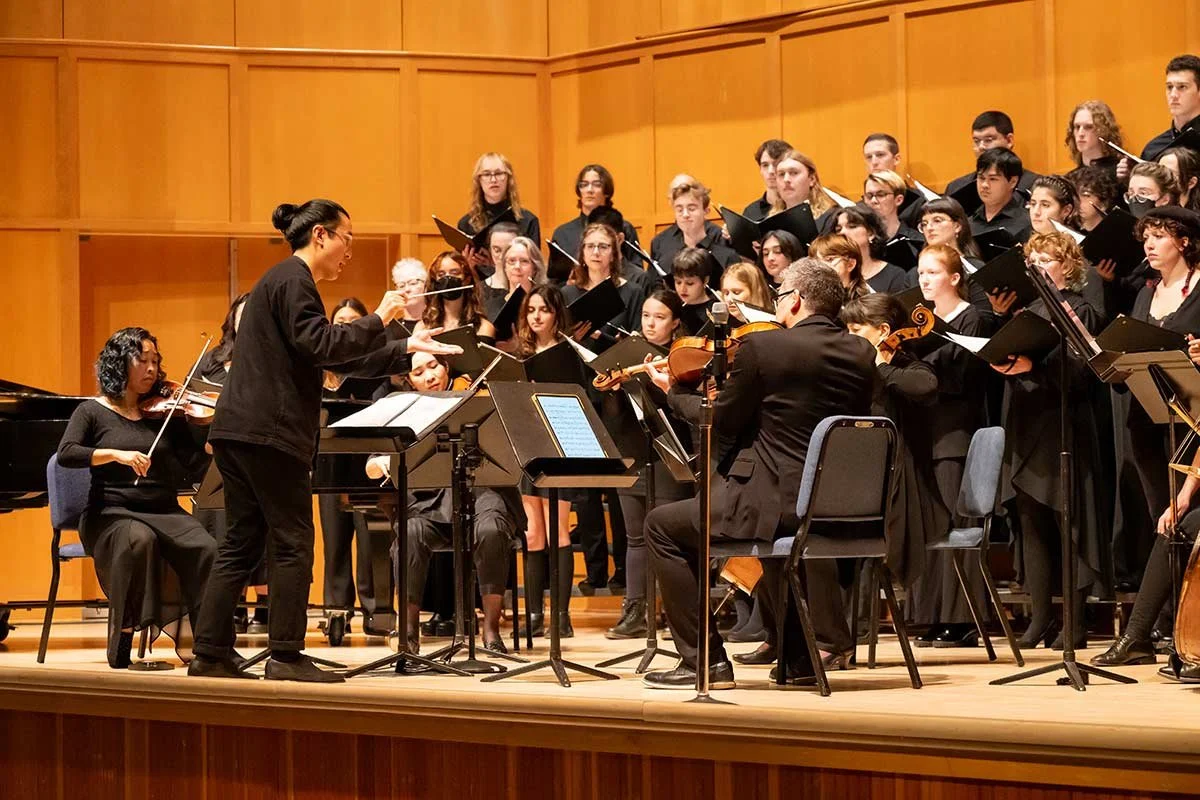
Fear No Music will join forces with Shohei Kobayashi and the Reed College Choirs, as well as flutists from Reed College, Lewis & Clark College, Portland State University, The Metropolitan Youth Symphony, Portland Youth Philharmonic, and Portland Public Schools for an immersive program featuring works by Henry Brant, Nancy Ives, Jukka Tiensuu, Pauline Oliveros, and Knut Nystedt. From quiet acts of attention to expansive, spatial sound—including Brant’s Mass for June 16—this concert is a meditation on listening, connection, and community.
PROGRAM
Kurt Nystedt - Immortal Bach, Op. 153
Reed College Choirs
Shohei Kobayashi, conductor
Pauline Oliveros - Tuning Meditation
Reed College Choirs
Shohei Kobayashi, conductor
Jukka Tiensuu - Rubato
Amelia Lukas, flute; Keiko Araki, violin; Amanda Grimm, viola; Nancy Ives, cello
Nancy Ives - Together Apart
Keiko Araki, violin; Amanda Grimm, viola; Nancy Ives, cello
Henry Brant - Mass for June 16
Amelia Lukas & Adam Eccleston
and the Fear No Music Flute Ensemble
Shohei Kobayashi, conductor
PROGRAM NOTES
from artistic director Kenji Bunch
Immortal Bach, Op. 153 — Kurt Nystedt
Nystedt’s work begins with a conventional performance of J. S. Bach’s four-voice chorale on the hymn “Komm süßer Tod (Come Sweet Death, BWV 478). The text is as follows:
Komm süßer Tod, komm selige Run!
Komm, führe mich in Friede.
Come, sweet death, come celestial rest!
Come, lead me in peace.
Following this initial presentation of Bach’s work, Nystedt asks each of the five choirs to repeat the chorale- but this time at five different rates. This creates what’s known as a prolation or mensuration canon, which unlike conventional canons that are organized around agreeably consonant harmonies, presents a blurring of melodic phrases that form clusters of harmony slowly traveling in and out of circumstantial dissonance to a haunting effect. This simple process with which Nystedt treats Bach’s chorale, in combination with the subject matter of the text, turns the beauty of Bach’s counterpoint into a mysterious and spiritual meditation.
Tuning Meditation — Pauline Oliveros
Like John Cage, Pauline Oliveros’ musical contributions extend well beyond her compositions into the realm of philosophy, questioning our very relationship with sound, art, and how we experience each other and the environment around us. Oliveros explores this in a mindfulness practice she pioneered called “Deep Listening,” and Tuning Meditation stands as one of the most important works in this genre. What appears to be an experimental vocal ensemble work turns into a moment of communal awareness and phenomenological discovery. The “performance” is an immersion in sound and harmony experienced by whomever is moved to participate, regardless of their musical background. The resulting sonic event is thus totally dependent on the spontaneous decisions of the particular members of the performing group that happens to be assembled.
Rubato — Jukka Tiensuu
One of Finland’s most prominent and prolific composers, Jukka Tiensuu has established an identity with his eclectic, unpredictable, and often whimsical work. In the lineage of composers from Debussy through Cage and Stockhausen, Tiensuu is more concerned with human intuition than process or architecture. Rubato demonstrates this with a simple page of music shared by all the musicians, that asks them to listen and respond to each other’s musical instincts. In this fashion, musical decisions traditionally dictated in stone preemptively by the composer are created in real time by the performing musicians. Tiensuu’s freedom extends even to the choice of instruments and their placement on stage.
Together Apart — Nancy Ives
Celebrated composer/cellist Nancy Ives has emerged as a creative force in the Pacific Northwest region, with both significant large-scale orchestral works as well as striking chamber and solo compositions. A longtime member of Fear No Music and Principal Cello of the Oregon Symphony, Dr. Ives writes the following about her work on tonight’s program- which marks the premiere of the string trio version:
“Commissioned for cello trio by Portland Cello Project and premiered on May 26, 2020 by Diane Chaplin, Valdine Mishkin and myself on Facebook Live and YouTube, Together Apart was written as part of an effort to keep artistic fires burning and to find ways to stay connected with audiences during that strange time. Knowing what we know now, it hadn't even been all that long into the pandemic lockdown, but we already keenly missed playing in ensembles and sharing our music with others. With each of us in our own homes, the software Doug Jenkins of PCP was using for the livestream allowed us to hear each other through our headphones, but did not eliminate the inevitable latency (delay) of internet transmission, so I wrote a piece that would work even under those conditions. I will never forget the feeling of playing chamber music with my wonderful friends Diane and Valdine after a couple months of solitary practicing! It was deeply moving and quite exhilarating. For that reason, and because feeling separate from others even when together is a universal human experience, this piece is special to me.”
Mass for June 16 — Henry Brant
A multi-instrumentalist and precociously experimental composer, Brant was known for his interest in spatialization and the eccentric instrumentations of his works. His Mass in Gregorian Chant calls for as many flutists as possible to perform his settings of plainsong melodies from the Graduale Romanum for the date of June 16th. In a fashion similar to both Jukka Tiensuu and Knut Nystedt, Brant begins each chant melody in unison, before each member of the flute choir gradually spreads apart from the others rhythmically. Unlike Nystedt’s thick clusters of harmony, the effect of Brant’s single melodic line overlayed by the subtle variations of many performers is the illusion of one supernatural flute playing in a vast cathedral with echoes swirling around the entirety of the space. In Brant’s own words, “the rhythmically uncoordinated configurations of the chant reveal melodic contours which automatically produce their own unique harmonic idiom.”
GUEST PERFORMERS
Reed College Choirs
Shohei Kobayashi, conductor
Soprano
Suzy Coleman
Zoe Cute
Jennifer Daunt
Kohei Do
Maya Franzen
Ava Gould
Az Greer
Ruby Holliday
Susan Kevorkian
Danielle Kyle
Polly Lambert
Arianne Lin
Isara Moriya
Isabella Roman
Isabelle Romero
Barbara Slader
Gloria Traktman
Mariia Vorozhko
Lily Washburn
Alto
Brie Alvarez
Skyler Andrade
Olivia Baker
Lauren Barber
Lilly Borrud
Sam Cotera
Maggie Craven
Angie Dimas
Miranda Dobkin
Laura Ehrlich
Dina Equbazgi
Charlie Fitzhardinge
Julie Fukuda
Chiara Galloway-Slick
Paris Harrell
Kate Howser
Anna Jones
Katie Kapustka
Annette Kirby
Zella Lobo
Anna McClendon
Ashley McCullar
Sydney Neifert
Stephanie Phelps
Nanati Safawo
Emma Schaedel
Kristin Scheible
Sandy Tanaka
Emma Treanor
Elayna Trucker
Laura Veirs
Tara Weling
Megan Withey
Emily Yu
Tenor
Aren Buchheit
Matthew Ching
Elliot Choi
Jay Cosnett
Jay Dickson
Daniel Fogg
Bose Hewitt
Sam Kuo
Max Ongbongon
Bass
Max Cooper
Zimm Davis
Nikolai Ewert
James Hodges
Lucca Jones
Sterling Kennedy
Benjamin Mayes
Nick McCullar
Clio McLain
Cole Robinson
Lumen Wang
Imber Weinstein
Mason Wordell
Marcos Wright-Kuhns
Haik Zacharian
Guest Flutes
We’re grateful to have flutists joining us from Reed College, Portland State University, Lewis & Clark College, Metropolitan Youth Symphony, Portland Youth Philharmonic, and Portland Public Schools.
Joaquin Socolofksy
Ellison Schwartz
Lydia Berry
Dana Sparling
Elena Kato
Lily Wong
Crislynn Duncan
Erin Kirkpatrick
Yirhe Ha
Ayush Wynkoop
Maja McCarthy
Sora Logue
Marilyn Ruthruff
Aili Deibert
Amara Martin
Maanya Singh
Vee Bartko