
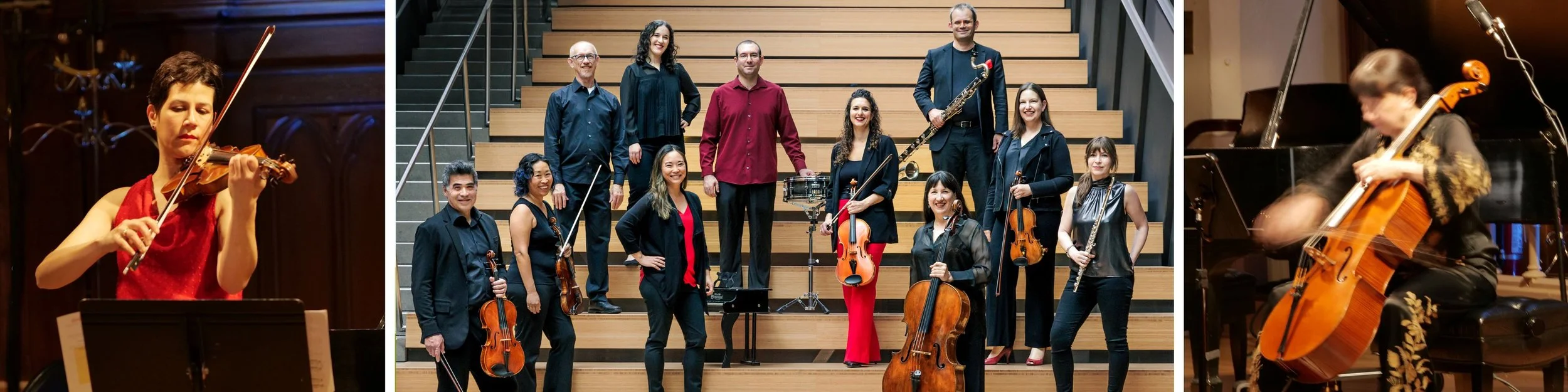
Locally Sourced Sounds Marathon: 2.0
November 13, 2026 | 7:00 PM
Eliot Chapel, Reed College
Following the tremendous success of our last season's inaugural Reading Session Marathon, we return this year with a new installment– a collection of new miniatures for small chamber ensemble, written by composers from our community– many of whom will be in attendance.
This concert features composers: Paul Safar, Lex Kornelis, Lisa Neher, Tao Li, Daniel Gall, Theresa Koon, Lisa Ann Marsh, Lukas Klotz, Priscilla Lane, I'lana Cotton, Dianne Davies, Liz Nedela, Barbara Ulman, Sy Brandon, Adrienne Albert, Carlos Carrillo, Penelope Griffin, Jan Mittelstaedt, Jerry H Casey, Keith Kullberg, Betty Booher, Elizabeth Blachly-Dyson, Ajit Phadke, Cody Wright, Nicholas Ferraro, Brian A Magill, Mel Grey, Maxwell Evans-McGlothin, Tara Jones, David Jones, Gary Lloyd Noland, Jason Fromme, Evan Hargrave, Lucie Zalesakova, Lifia Teguh, David Ortiz Baez, Paul Henerlau, Rick Martin, Elaina Stuppler, Stacey Philipps, and Jeff Winslow.
PROGRAM
Set 1 (7:00)
Dianne Davies - Vortex
Carlos Carrillo - Cantata
Tara L Jones - Brown Leaves in Blue November
Jason Fromme - La Mahonesa
a 60 second love affair
Evan Hargrave - The Crux Constellation
Stacey Phillips - I have mixed feelings
Paul Safar - Romanza-The Candle’s Flame
Lisa Neher - branches
Set 2 (TBD)
Lisa Ann Marsh - Orkney
I’lana Cotton - Temporary Landscapes
Barbara Ulman - Reverie
Adrienne Albert - Reflections
Jerry Casey - Lydian Merry-Go-Round
Lucie Zalesakova - Hijinks
Elaina Stuppler - Chromatology
Tao Li - Parthenocissus Tricuspidata
Gary Lloyd Noland - String Quartet No. 2, Op. 32
No. 3 & 4
Jeff Winslow - Deep River (arrangement)
Cameron Bryzek - Reflections
Priscilla Lane - Swim Easy
Penelope Griffin - Intersection
Cody J Wright - Book of Puppets
x_prologue
Set 3 (TBD)
Lukas Klotz - Somewhere Else
Keith Kullberg - Neolonga Marston
Betty Booher - May His Memory Be a Blessing
Elizabeth Blachly-Dyson - Music for A Rainy Afternoon
Lifia Teguh - Genesis
Paul Henerlau - Sunrise Bagatelle
Lex Kornelis - Comfort of the Unknown
Daniel Gall - The Color Wheel
Liz Nedela - The U.S. Visited
V. The West Coast - Highway 101
Set 4 (TBD)
Sy Brandon - Festiva
Jan Mittelstaedt - A Walk in the Woods
II. Songbirds
Ajit Phadke - String Quartet in F
III. Andante
Nicholas Ferraro - Universal Bones
Brian Magill - Brief Encounters
Maxwell Evans-McGlothin - Resolution 37/43
(Repugnantia Perpetuum)
David Jones - Pelog
I. Moderate waltz
Theresa Koon - Destruction Scene/Rage of Innocence Lost
David Ortiz Baez - le rêve
Rick Martin - Untitled
Mel Grey - Sublimity
BIOS &
PROGRAM NOTES
from the composers
Paul Safar

-
Paul Safar is a composer/performer and piano instructor based in Eugene, Oregon. The 2024 winner of the Orchestral Composition Competition of the Brazosport Symphony, Paul has also had commissions from ensembles such as the Delgani String Quartet. His chamber music has been performed in cities from Seattle and Havana to Aryens de Mar, Spain. Having a background in both classical and jazz/rock, one of Paul’s goals is to coherently combine these influences in his compositions. He enjoys collaborations both near and far, finds joy in musical experimentation and has produced an ongoing monthly music series at Tsunami Books in Eugene. Paul received his Bachelors degree from The University of Cincinnati (CCM) under Joel Hoffman and did graduate study at the University of Oregon under Robert Kyr. When not musicking, he may be seen hiking, traveling, sipping a vino tinto or spending time with family and friends. For more information visit www.paulsafar.com
-
This short piece is meant to invoke the warm glow one gets sharing a candlelit dinner on a cozy winter evening with a special someone.
Lex Kornelis
-
Lex Kornelis is a sophomore at Carnegie Mellon studying Biological Sciences and Music Composition. Her style ranges from classical to electronic to rock, willing to try anything. She hopes to one day be a composer for film and video games. Her style is simple but evocative, aiming to create a sense of mood and tell the listener a story.
Lex has worked with the CMU Game Creation Society on twelve different indie video games, including Crustacean Station, which is currently being sold on Steam. She has previously composed Rising Paranoia, which the Metropolitan Youth Symphony premiered in her hometown of Portland, Oregon, and additionally worked with them again to orchestrate for pop singer Jimmie Herrod, which was later played on All Classical Radio. She hopes to continue working on multimedia projects with fellow CMU students.
-
Comfort of the Unknown is a piece about inspiration. The piece starts calm and slow, almost hesitant, before breaking into a much faster rhythm. A few measures of 9/16 and 3/8 sneak their way in, acting as hiccups in the piece, but they quickly return back to much more stable – but still shifting – time signatures.
Written in F Lydian, the especially bright yet unstable character of the mode translates to a piece that is tentatively hopeful, capturing the feeling of having an idea you’re excited about but not being sure if you can live up to its full potential. The ending of the piece returns to the slow whole notes of the beginning, but with an important difference: a chromatic chord that switches the key of the piece at the very end, the inspiration finally realized.
Lisa Neher
-
Multi-talented mezzo-soprano, composer, and actor Lisa Neher “create[s] soundscapes of shimmering color, offering moments of unexpected intimacy and grace" (The Flute View). A “maestro of beautifully wacky noises” (Oregon ArtsWatch), her works demonstrate consummate skill in instrumental and vocal writing, producing strikingly imaginative and finely honed music that enthralls listeners and carries them on a vivid journey. Neher’s expansive catalog includes “wildly inventive” (Willamette Week) song cycles, operas, chorale works, and chamber music which showcase her “liquid, impressionistic…writing and fluent melding” of voices (New York Classical Review). Neher is an award-winning composer whose music has earned recognition from the Oregon Music Teachers Association (Composer of the Year 2025), the Flute New Music Consortium, ICDA/ICF, Mirror Visions Ensemble, and the Celebris Ensemble. Commissioning ensembles and organizations include the National Association of Teachers of Singing (NATS), American Harp Society, Cincinnati Song Initiative, and Opera Santa Barbara. Her interdisciplinary training informs her compositional craft, making her an exceptional musical storyteller with an uncommon command of dramatic pacing, orchestration, and musical colors. Through all facets of her work, Neher champions contemporary storytelling that embraces both the wildness of the natural world and the intimate complexities of human experience. lisanehermusic.com
-
branches is a companion movement to my piece seedling, which was written as a gift for my Grandpa Bernie Harvey in honor of his 80th birthday. He was an avid gardener of corn, pumpkin, roses, apples, and all manner of growing things and a quiet and thoughtful listener. All things that grow sprouted and thrived under his loving care. branches was commissioned by Third Angle New Music as a birthday gift to Ronni Lacroute. Ronni is an amazing force of philanthropy and support of the arts in Portland. Her energetic, joyful spirit and enormous generosity inspires everyone she touches with her wide-reaching arms.
Tao Li
-
Award winning composer Li Tao was born and raised in Beijing, China and currently based in the U.S. teaching in the Music Technology area at the University of Oregon School of Music and Dance, where she earned both of her Ph.D.s in Music Composition and Data-Driven Music Performance & Composition. The philosophy, literature, and spirituality of the ancient East play a formative role in the aesthetic of Tao’s work. Her music consists of vivid soundscapes, colorful timbres, and interdisciplinary elements that often lead her audiences on a multi-dimensional journey full of imagination. As an Asian female musician, Tao is devoted to promoting gender equity and cultural diversity through her music as well as through collaboration with other artists.
Tao’s music has been performed at concerts and music festivals throughout the world including China, Japan, Korea, Australia, Ireland, Belgium, Ukraine, Brazil, and the U.S.A. Her primary interests include acoustic and electroacoustic composition, performance practices, and analysis of compositional techniques, aesthetics, and intercultural dialogues.
-
This piece was written for Amorsima Trio for their miniature project in celebration of Beethoven’s 250th birthday in 2020. Despite the large creative freedom given by the trio, I have decided to use limited musical and technical materials in this miniature. I take the two famous pitches from the beginning of Beethoven’s fifth symphony as musical materials and imbed the rhythmic motive of the two pitches at beginning and the end of my piece. The interval of the two pitches can also be heard throughout the piece. Parthenocissus tricuspidata is a climbing ornamental plant that is vigorous, fast-growing, and widely cultivated. Many aspects of this plant are reflective of this piece’s instrumentation and musical texture.
Daniel Gall
-
Daniel Gall is a composer who fled civilization after grad school to go live off the grid on a small farm in Oregon. After more than a decade of this lifestyle, he's only recently returned to Portland in search of community and opportunity, and to compose opera.
Over the years, Daniel has collaborated with a variety of musicians, ensembles, filmmakers, and choreographers/dance companies, including the Port Townsend Symphony Orchestra, the Symbiosis Chamber Orchestra, the Glendale Philharmonic, the Definiens Project, the Vientos Trio, Mignolo Dance, Forza Dance, and many others. During 2020-22, he produced a social media series called PROJECT SCREENDANCE, where he collaborated with a different set of performers on a new dance film short each month, resulting in 24 new dance films featuring his music. Daniel studied music at UCLA, and before he fled the grid long ago he was the founder of the Los Angeles based new music organization and concert series, Synchromy.
In addition to his work as a composer, Daniel is also a novelist who writes often-satirical and dystopian fantasies based on his experiences off the grid. He strives to connect his musical and literary works through fantastic themes and imaginative concepts.
-
The Color Wheel is the second scene from a dance-fantasy suite called Paradise, about a poor wanderer who is chosen to join the exclusive Cult of Paradise in their luxurious Resort-Temple. But beware, for Paradise is not what it seems, and the chosen shall each be put to the test before the end. The string quartet movements in this suite are like sketches for a ballet that were then orchestrated and expanded, but this is the original string quartet version.
In this scene, the wanderer has just entered the compound, and he presents himself to the cult to be sorted. Spin the wheel, win a prize!
"Abrupt blinding lights fill a hall that, at first, appears glittery and fantastic, but upon closer inspection is all cheap plastic and corporate art. At the center of the space is a vertical, lottery-style color wheel, surrounded by the Beautiful People, dressed lavishly and drinking sparkling wine. Everyone is smiling and happy, and the wanderer is brought forward to spin the wheel. It lands on green and everyone cheers. He's offered some wine, and a beautiful woman takes his hand and leads him to a green door at the back of the hall. She gestures for him to enter, and he does. The door closes and locks behind him."
Lisa Ann Marsh
-
The heart of Neolithic Orkney is a group of 5,000-year-old sites on the mainland including rings of giant stones and preserved ancient villages. The strength and heritage of the Pics/Scots are reflected in the landscape and in the songs and dances of the people.
Lukas Klotz
-
Lukas Klotz is a composer, multi-instrumentalist, and researcher based in Salem, Oregon. Working primarily across chamber and acoustic idioms, his music balances structural precision with intimate lyricism, informed by his background as a pianist, violist, and choral singer.
Priscilla Lane
-
For me, writing music started about seven years ago and is still ongoing.
I write at the piano. Some pieces start while walking at low tide, paddling in a kayak or swimming. They are developed at the piano and tested on the trombone.
What is my music history? Most recently I play with an ensemble of five who work on my compositions. I started studying trombone ten+ years ago with Dave Bones. He suggested that I try composing and has continued to be a mentor for me through this process… a process that has brought me many a quandary, resolving in pleasure and awe.
I play with the New Horizons Big Band and the One More Time Around Again Marching Band (32 years, clarinet, then trombone). I have played the Gendèr Barung in the Lewis and Clark College Gamelan, sung with a Balkan choir, a madrigal choir at UC Berkeley, a choir at Middlebury College under direction of Jean Berger.
The compositions I write now, although emerging out of a jazz structure and jazz modes, are also influenced by my past musical life.
-
A Jazz Swing piece for flute, clarinet or alto sax, cello or trombone, and piano.
As a swimmer, I enjoy a certain peace surrounding me, in the space above the water and in the water that holds me. As I swim, the music starts.
As a swimmer, the rhythm of my movements projects me through the water, in vertical and in horizontal space. The music goes on.
I’lana Cotton
-
I’lana Cotton is a composer, improviser and pianist who holds a Master of Arts degree in composition from UCLA. As a San Francisco Bay area resident for many years, she was active throughout the area as a modern dance accompanist, composer, and music educator. Since moving to southern Oregon in 2003, she has written over 40 works for Rogue Valley musicians and ensembles. The Rogue Valley Symphony commissioned Cantus, a large-scale work for orchestra, in honor of its 50th anniversary season, which was premiered in October, 2017. Recent performances include those by Oasis Ensemble, Metollius Trio, Rose City Brass Quintet, Masterworks Serenade Chamber Choir, Avenue Winds, Willamette River Horn Quartet and Rogue Winds. An active member of NACUSA since 1990, she helped form the Southern Oregon chapter in 2007. Since 2024, she has made her home in the coastal town of Florence, OR. You may visit her website at www.notimemusic.com.
-
This is from a suite of 5 pieces for clarinet and piano entitled Temporary Landscapes.
Dianne Davies
-
Dianne Davies is a collaborative pianist, composer and teacher. Her musical roots harken back to childhood growing up in a musical family where her mom was a church pianist and choir director. Early on, Dianne began playing tunes by ear and then serving at church by ten years old. She is a published arranger and composer that operates a full piano studio consisting of beginners, advanced players and recreational adults. Her students are given the opportunity to unlock their own creativity in composition and arranging. Her education includes a Bachelor of Arts degree in piano performance from Lewis and Clark College and K-12 public school instruction certification. Dianne is deeply committed to creating and performing new music. Her music centers on the natural world and life experiences. Dedicated to the next generation of composers, she is active at both the state and national level of OMTA (Oregon Music Teachers Association) where she gives presentations that include tips and tricks for teaching composition to chairing the State Composition Competition for MTNA (Music Teachers National Association). When not doing music, you can find her English Country Dancing, reading Jane Austen or enjoying the outdoors. Check out her music at diannedavies.com
-
In Gold Hill, Oregon the Vortex awaits. Local Native American legend refers to this site as a “forbidden land” as their horses refused to enter the area. The word vortex simply means a whirlpool of force. In this case, The Oregon Vortex is a spherical, magnetic field, half above ground and half below. At “Gravity Hill” objects roll uphill and in “The House of Mystery,” one walks upright yet is diagonal to the earth. Paranormal activity or optical illusion? Either way, as you listen, imagine yourself in a world where the unusual is commonplace.
Liz Nedela
-
Liz Nedela, MM, MEd, BA, composition, piano and strings. Liz is fond of contemporary composition techniques, counterpoint, ethnic, modal and early music, and weaves these aspects into her compositions. She writes music in many genres, instruments and voice, completing commissions from music teachers organizations, church, orchestra, chamber music, Women’s Music festivals, and concert soloists and ensembles. Several pieces are archived in universities and have been broadcast on public radio. She also enjoys writing music for children and teaching pieces for students. She has earned an MM in composition, University of Montana, (winning a Composer Showcase award and scholarships); and a BA and MEd with focus on piano, composition, English, and theater, devising a program for teaching composition. She served as the Montana State and the Northwest Division chair of composition for MTNA (Music Teachers National Association). In 2014, Liz was awarded the WSMTA (Washington chapter of MTNA) Composer of the Year, resulting in Penta-Moods, a study in pentatonic modes. She is an active member of Cascadia Composers and other music organizations, and has served as adjudicator in piano and composition. Liz resides in Vancouver, WA and Port Huron, MI.
-
The West Coast - Highway 101 - The fifth movement of The U.S. Visited, the fast-paced West Coast is light in character. This highway is the fastest in the country, with cars speeding all the way, impatient with each other, but always good-natured. A more traditional scale is used, but is rhythmic, containing motifs that represent car horns, and erratic driving. Watch the ending! Like the drivers, it is full of surprises! Wait for the “last word!”
Barbara Ulman
-
Barbara Ulman began piano lessons at age seven. Five years later, she was hired to play the piano during a friend’s flute lessons. This was the start to her life as a collaborative musician. She accompanied her high school glee club and various soloists as needed, sang in a choir, and while singing Fauré’s Requiem, realized the power of music to move her deeply.
She graduated from Harvard/Radcliffe College, in Cambridge, Massachusetts, with a combined concentration in psychology, anthropology, and sociology, while also studying piano chamber music at the nearby Longy School of Music.
After completing ten years of teaching, including classroom music, she moved to a small town in the foothills south of Yosemite National Park in California. In 1989 she completed a second B.A., concentrating in Music Theory and Composition, at California State University, Fresno. She moved to Portland, OR in 2021.
She continues to be an active chamber music player, for fun and for public performance. Her many years as choral singer, and also pianist for solo singers and for choruses created a special affinity for the human voice. She has composed art songs and music for small ensembles and for chorus.
-
I had played the piano since age 7, but didn't consider writing music until I was 39. Then I took a composition seminar at California State University, Fresno. The second assignment was to write a piece in one of the modes. I chose the Phyrigian mode, played around on the piano till I heard something I liked, and wrote it down. The original title was Phyrigian Reverie. My method was more intuitive than analytical. I had to repeat the scale twice in the piece in order to stay in that mode. TwelveI years later, after studying music theory and many other classes, I completed a degree in music theory and composition. Reverie now has a companion piece. Reverie and Rondo are on my YouTube Channel with attractive video enhancing the sound.
Sy Brandon
-
From performances of his music on NPR’s “Performance Today” to the use of his music on TV’s “Animal Planet” and MTV’s “Never Before Scene”, Sy Brandon’s compositions and arrangements are as varied as they are accessible. His music has been performed live and via broadcast throughout the United States and abroad, including performances by the United States Army, Navy, and Air Force Bands. Sy Brandon has received numerous awards including first prize in the WITF-FM's 25th Anniversary Composition Contest and the Quadre Composition Contest. In 2010, he was awarded a commission from the Arizona Commission on the Arts to compose the band composition celebrating the Arizona Centennial during 2011-12. His music was selected as American Prize finalists and semi-finalists during 2012 and 2013. He is the recipient of the 2018 Thor Johnson Memorial Commission sponsored by the Delta Omicron Foundation. The Czech National Symphony Orchestra, the Philharmonia Bulgarica and the Kiev Philharmonic have recorded his music. Sy Brandon holds the rank of professor emeritus of music from Millersville University, Millersville, PA. He received his B.S. and M.S. in music education from Ithaca College and his A. mus. D. in composition from the University of Arizona.
-
Festiva is a joyful composition in Rondo Form (ABACABA). Its energy comes from the use of mixed meters and a lively tempo. The C section is more lyrical than the our sections and the melody develops through modulation.
Adrienne Albert
-
“Reflections” has had numerous performances around the world. A “Beautiful melody with underlying harmonies that transcend boundaries of classical and pop music”, this piece has had several incarnations. Originally conceived for saxophone quartet, the wonderful saxophonist, Doug Masek, asked me to transcribe it for soprano saxophone and piano. Due to its universal appeal, I have transcribed “Reflections” for clarinet and piano, flute and piano, violin and piano, oboe and piano, and cello and piano. All versions have had successful performances with musicians and audiences alike. Published by Kenter Canyon Music (ASCAP), “Reflections” may also be purchased through T Front and TrevCo Music. More information about this and other works can be found at http://www.adriennealbert.com.
Carlos Carrillo
-
Born in San Juan, Puerto Rico, Composer Carlos Carrillo holds degrees from the Eastman School of Music, Yale University, and the University of Pennsylvania. He is the recipient of numerous awards, including the Bearns Prize, the Ives Scholarship from the American Academy of Arts and Letters, a Chicago Opera Theater Fellowship, Chamber Music America, and BMI and ASCAP awards. He has taught composition at DePauw University, Reed College, and the Puerto Rico Conservatory of Music. Currently, Dr. Carrillo is Composer in Residence with the New England Philharmonic and an Associate Professor of Composition/Theory at the University of Illinois Urbana-Champaign.
-
Cantata was written for a concert in Boston of short pieces for solo viola. All the pieces were based on Psalms, and I contributed a setting of Psalm 130, De Profundis. I set a few challenges for myself in the composition: to write a Lutheran Cantata in multiple movements for a single instrument. The piece has four movements:
1. Sinfonia
2. Recitativo
3. Aria
4. Choral
Penelope Griffin
-
Occasionally, when I'm in some sort of transitory, liminal space (such as a highway, a bus, or an airport), I find myself wondering about the lives of the people around me. These spaces are temporary, meant to be passed through. However, because we all pass through them together, it leads to a place where so many different people, all there for different reasons, from different places, and on different walks of life, share a space just for a brief moment. Even though none of them will likely ever remember seeing each other there and the space itself will be largely unchanged by most of them, their lives have intersected.
My piece, "Intersection," was inspired by this thought. Throughout the first half of the song, instruments will chime in playing certain ostinatos and swell at different points, not always fully lining up but still creating a beautiful blend with the instruments that they cross with. Occasionally, instruments will either break through or join the blend with a long note. Meanwhile, the two note ostinato in the piano is meant to represent the space where this intersection takes place. Eventually, in the second half of the song, all instruments will begin lining up, while still swelling in different places, until eventually the harmony that the ostinatos create will finally break through and all instruments will finally swell together, representing the moment of intersection. At the end of the song, all instruments take their leave at different points, leaving the space empty. The song ends with the two note ostinato in the piano continuing into nothing, signaling that the space will continue on, that this intersection was just a brief snapshot of the lives of the people involved and of the space itself.
Jan Mittelstaedt
-
Jan Mittelstaedt, NCTM holds a B.S. in education, Bucknell University; B.A. in music, Marylhurst University; and M.M. in composition from The University of Portland. Honors include: Ernest Bloch Composers Symposium, 1993; OMTA Composer of the Year, 1994; ASCAP special awards; published piano music; piano pieces in two NFMC Festival bulletins; and 2020 semi-finalist in the vocal chamber music division TAP in Composition and finalist in 2021- 2023, and 2025. A teacher of piano, Nationally Certified by MTNA, Jan has adjudicated many student compositions, given workshops on composition pedagogy to teachers, and in 2023 received the Nellie Tholen Excellence in Teaching award from OMTA. She is founder and former chair of OMTA’s educational program, Extended Study of Musicianship and Repertoire (ESMAR), a former member of the OMTA syllabus adjudicating staff, and a former president of Cascadia Composers. She remains on the board and is chair of Cascadia Composer’s annual In Good Hands student concert. Through OMTA, she received Portland District Honorary Lifetime Membership in 2013 and Honorary State Life Membership in 2017. She has 2 sons, a daughter, and 8 grandchildren. Her composition mentor is Dr. Walter B. Saul II.
-
This piece was inspired by Beethoven's String Quartet, Op. 130. As I studied Beethoven's work, I found rhythmic and melodic motives that inspired me. We have been experiencing an especially beautiful fall in Portland. I love walking or driving on treelined streets under the vivid colors of the leaves. So, my first movement is called "Under Dancing Branches". The second movement feels, to me, like a meditative walk under the trees. Suddenly, about halfway through the movement, I hear birds singing and flying around. Thus, I named this movement "Songbirds". Obviously, the set is called A WALK THROUGH THE WOODS.
Jerry Casey
-
Jerry Casey, Naples, Florida, composes music in all genres. Her twenty-one premieres from 2022 through March of 2026 were in seven states. These included works for piano, vocal and instrumental ensembles, art songs and a choral anthem. The art songs were the result of collaborations with students of voice teacher friends. Collaboration with musician friends in several states resulted in the vocal and instrumental ensembles. The piano works resulted from collaboration with young students for the In Good Hands recital in Portland, Oregon sponsored by Cascadia Composers, a chapter of National Association of Composers USA.
Other performances of Mrs. Casey’s works have been in England, China, Slovakia and Spain. She has received the ASCAPLUS Award for over 25 years.
Mrs. Casey released a CD, Yet I Will Rejoice, featuring her choral and vocal chamber music. Seven (A Suite for Orchestra) and Gli intrighi d’amore for Woodwind Quintet and Narrator were released on an MMC CD.
Mrs. Casey has degrees from Texas Woman’s University, Denton, Texas and Gateway Baptist Theological Seminary, Ontario, California. She is a former faculty member at University of the Cumberlands, Williamsburg, Kentucky, and a former adjunct teacher at Florida Southwestern State College, Ft. Myers, Florida.
-
Written in Lydian mode, this short duo begins with the clarinet stating its theme in a low register. The flute enters with its theme against the clarinet in a higher register. They then swap themes. Next they play them in retrograde one after the other in a little chase. Finally, the piece settles with both instruments playing the opening theme an octave apart and rushing to a climax. What a merry-go-round!
Keith Kullberg
-
Keith is an amateur musician and composer. He has written about 40 pieces over the years, mostly piano / violin and guitar / violin duets. He started piano lessons at age 7, and played piano in a jazz band at the Oregon State University school of music. He organizes and hosts the Southwest Salon House Concert Series featuring a mix of original music by local jazz musicians along with classical music ensembles. His pride and joy is his Mason Hamlin BB Grand, usually featured in the house concerts. But his favorite solo instrument that he doesn't play is the violin.
-
A neolonga is a dance form for tango nuevo music. This is a dance and musical piece for lovers slowly building up from a tender beginning to a passionate climax. Inspired by Astor Piazzolla the original Tango Nuevo composer. Composition dedicated to Portland pianist and composer Todd Marston.
Betty Booher
-
Betty Booher studies composition at Portland State University with Kirsten Volness. She formerly studied with Renée Favand-See. In addition, she is the ‘squawk’ half of the jazz duo Bellows & Squawk, playing clarinet and saxophones and singing.
Betty holds a BA in Music from Reed College, where she played oboe and English horn, and is an alumna of the Portland Youth Philharmonic. She identifies as an old lady, but as a young composer, having begun writing music only since her recent return to college.
Her double reed quartet, the Emmett Variations, was an International Double Reed Society’s ’50 for 50’ competition winner, featured at the 2024 IDRS conference in Flagstaff, Arizona. Her trio, Memorial for the Victims of War was premiered by Fear No Music in September 2025. Her piece Pilgrimage: Tuscany was premiered at the Walden School’s Creative Musicians Retreat in Dublin, NH in June 2026. A new work, Sunday in the Park in Mexico City, will be premiered Saturday November 14th, by the Nonesuch Reed Quintet at the Leaven Center in NE Portland.
Returning to school had been a longtime goal. Betty is delighted to have the opportunity to tell stories through the medium of music.
-
May His Memory Be a Blessing was written as a memorial for my late husband, who passed away from pancreatic cancer several years ago. Having gone through this experience and its aftermath, I realized that much of our society is death averse, and once the funeral service is over, everyone involved is expected to return to their normal lives as if nothing had happened.
I wanted the music to contrast the solemn formalism of the funeral dirge with the expressions of anguished grief that erupt after the death of a loved one, often at inconvenient times. We hear this contrast voiced by the clarinet and then the cello just after the opening, with the melody returning, as if to try to rein in unseemly emotions. In the middle section the players pass around fragments of the melody, but with added layers of anxiety, before finally returning to the opening dirge.
Elizabeth Blachly-Dyson
-
Elizabeth Blachly-Dyson enjoys composing music for large and small ensembles. She has written pieces for the Camas/Washougal Community Orchestra, the Marylhurst Orchestra and the Pacific Crest Youth Sinfonietta. Her piece, “Together” was performed by the BRAVO Youth Orchestra at Governor Kate Brown’s inauguration. Her chamber works have been performed at concerts organized by Cascadia Composers, Fear No Music, and the Crazy Jane Composers. Elizabeth has studied composition with Dr. Robert Priest, Tomas Svoboda, Jonathan Newman, and Kenji Bunch. You can listen to some of her music at https://soundcloud.com/blachly-dyson.
-
“Music For a Rainy Afternoon” is a shortened version of the first movement from a weather-themed string trio that I wrote during the COVID lockdown at the request of violinist Tatiana Kolchanova. The trio has never been performed. It is a wistful reflection on gloomy times with occasional angry outbursts, but a hopeful ending.
Ahit Phadke
-
Ajit Phadke is an amateur pianist and composer in the Portland area. As an undergraduate, Ajit studied composition and orchestration with Alan Stout as well as others, and piano with Carmen Or and Sylvia Wang. In addition to his Bachelor of Music in Composition from Northwestern, Ajit also has degrees in Electrical Engineering (Northwestern) and law (Lewis & Clark). Ajit's compositions are rooted in his background as a (Western) classical musician, and his composition portfolio ranges from short pieces for solo piano to tunes for jazz ensemble to a symphony for a late-Classical-era orchestra. Contact at ajitpmusic@gmail.com
-
This is the third movement of a 4-movement classical string quartet from 2025.
Cody J Wright
-
Cody J Wright is a composer, guitarist, and educator based in Lake Oswego, Oregon. His music has been performed in the United States, France, Japan, the Netherlands, and Spain, by artists including the International Contemporary Ensemble, the Flux Quartet, the yesaroun’ Duo, and pianists Izumi Tateno and Sergey Schepkin, and at venues such as Jordan Hall in Boston and La Schola Cantorum in Paris. His orchestral work Temps Perdu won the Harry G. Archer Memorial Student Composers Orchestra Competition.
He earned composition degrees from New England Conservatory and Carnegie Mellon University, with further study at CalArts and the European American Musical Alliance in Paris. His teachers include Alan Fletcher, Morton Subotnick, James Tenney, Leonardo Balada, Lee Hyla, and Michael Gandolfi.
A longtime educator, he served on the faculty of the Walden School, where he received the Patricia Plude Faculty Fellowship. After a career in Learning & Development at Apple and in his own consulting practice, Cody has returned to composition, bringing a guitarist’s ear for rock and metal into the concert hall.
-
Book of Puppets reimagines Metallica’s Master of Puppets album through the workings of musical memory. When we replay music in our minds, we rarely recall it verbatim: certain passages loop insistently, melodies migrate onto different rhythms, details become embellished, and entire sections expand, contract, or disappear. The music we remember becomes, in some measure, music we have remade.
The project was initially inspired by Christopher O’Riley’s transformative piano arrangements of Radiohead, which retain their source material while discovering new textures and expressive possibilities within it. Book of Puppets ventures further from the structures of its source, combining recognizable quotations with fragments that are reordered, layered, distorted, or only partially remembered.
“x_prologue” is the opening movement of the Book. Like the introduction to Metallica’s “Battery,” it functions both as the beginning of a particular piece and as an overture to the larger collection. Alongside material from “Battery,” fragments of other songs emerge as fleeting recollections and premonitions.
Listeners familiar with Master of Puppets may recognize these fragments as they surface in altered surroundings. For those encountering the material anew, “x_prologue” offers a brief glimpse into the musical world from which the rest of the Book unfolds.
Nicholas Ferraro
-
Nicholas Ferraro is a composer, pianist, and writer living in Vancouver, Washington. His work "Universal Bones" premieres as a part of this year's Locally Sourced Sounds Marathon. He has an associate's degree in music from Clark College and has studied composition privately with American composer Scott Wollschleger. He holds a bachelor's degree in English from Washington State University and has published poetry in The Ocotillo Review and Abraxas Review. Whether through words or music, his work tends to focus on the search for sincerity, connecting the past to the present, exploring the inexplicable, and the triumph of being alive.
-
"Universal Bones" aims to provide a structure for joy in the process of being together and the experience of finding the universal shape of human connection. The structure consists of developing a single melodic idea in ways that unite the ensemble. Sometimes this melody is heard against itself in a canon. At other times it is bound to one of the variety of clave-esque patterns that are passed around the ensemble as the piece progresses.
Brian Magill
-
Brian Magill is a composer from Portland, OR. After obtaining his music degree from the University of Oregon, he became interested in electronic music and was one of the founders of the Eugene Electronic Music Collective at the beginning of the "Home Studio" movement. He has done music and sounds for educational film and spent 10 years composing and performing all incidental music and sound effects for the Avant-Guard Theatre group Thringst. He spent 35 years as a software engineer in the high tech industry and raising a family, releasing two CD's of his electronic music. After retiring, he has sought to combine his interest in Jazz, Classical, World Music and Un-popular popular music with Classical Forms and instruments.
-
This is a perfectly good movement for string quartet squished and compacted into 3 minutes to comply with the submission requirements. Most of the interesting parts remain.
Mel Grey
-
Mel has logged hundreds of hours as a piano accompanist and collaborator for choirs, solo singers, cellos, flutes, orchestras, rock bands and small ensemble. He has completed several compositions, as well as some that have been performed live, with pieces such as 'Cobblestone' and 'The Plague of Doubt', as well as his three movement 'Fugue Feud' and his two movement 'Dark Chocolate'. He is currently in the process of writing three more compositions, including a string quintet inspired by Dvorak and Debussy, a lighthearted small ensemble and a challenging solo piano piece that he has described as 'a cross between an etude and a sonata.' OMTA recognized him as an 'Honored Composer' in both 2025 and 2026.
-
This piece was constructed to evoke feelings of heroism and wonder while individuals (each instrument) come together to create something beautiful (hence the name Sublimity).
The beginning dramatizes an increase in the instruments while the violins and piano tremolo to support the build. This transitions to a marching style that is reinforced by the piano while the other instruments share a more free melody over the top.
The melody takes hold and focuses less on the rhythm while still building in tension. Eventually, the tension is released with a series of arpeggios that move towards the summit of the song. Once part H is reached, the dynamics become free flowing to allow for the full character of each instrument to come alive.
Using a variant of the original march, the song then moves towards its conclusion with a 'book ending' of the beginning, yet with the melody slightly more emphasized and mysterious. However, the mystery gives way to the grand finale as it exits the piece with a bold and triumphant chord.
Max Evans-McGlothin
-
Maxwell W. Evans-McGlothin (b.2008), is currently attending Boston University to study music composition and political science, philosophy, and economics (PPE). Max began composing in 2017 with the NY Philharmonic Very Young Composers program. Max spent eight years with the Fear No Music Young Composers Project (FNM-YCP) in Portland, OR with his work performed by the Metropolitan Youth Symphony (MYS), the Oregon Symphony, the FNM Ensemble, the FNM-YCP Ensemble, Bang on a Can, and the MYS Camerata. Max also had a piece commissioned and premiered by the Young Artist Institute for Chamber Music Northwest’s 2026 Summer Festival; Confluence: OurShared Voices. Max received his IB diploma from Cleveland HS in Portland, OR, was a member of the National Honor Society, Student Council, founder of the Dungeons & Dragons club, and was in C.A.R.E Leadership.
Max was honored twice by the Oregon Music Teachers State Composition Festival (‘24/’25). Max studied composition with Dr. Ryan Francis and piano with Dr. Stephen Lewis for eight years while in the FNM-YCP. Max is currently studying composition under the guidance of Dr. Rodney Lister, engaged in BU’s own active art community, and performs in the Times Arrow Ensemble.
-
Dedicated to the resilient people of Iran, Lebanon, and Palestine.
Dedicated to those, who in the face of colonial barbarity, take up arms to liberate their people, their land, their humanity.
Tara L Jones
-
Composing music is one of my greatest joys in life. There is nothing quite like sitting down at the piano or touching my fingers to the strings of my guitar and discovering the first notes of a new piece or song. I suppose this is why music has followed me on my many different life paths. As an elementary school teacher, yoga instructor, mother, friend and actor I have found myself inspired to write music for my students, children, friends and fellow thespians. My musical training, both formal and informal, has also been a constant in my life beginning in utero when my mother was a Broadway dancer and continuing on with opportunities to work with teachers of piano and composing in every city I have lived in over the past six decades. I am deeply grateful to have received the double gift of being able to both perform and compose music. I am delighted to have the additional gift of sharing my music with you.
-
"Brown Leaves in Blue November" was not written with late fall in mind. I do occasionally write piano compositions to capture an emotion, place or event or as a musical portrait. The majority of my pieces however I discover when my fingers touch the piano keys. I find the first notes, the first bit of melody and the rest flows from there. The title was a gift from a former piano teacher after I shared a recording of the piece with him. My preference is to leave my compositions untitled to allow listeners to form their own images but I found "Brown Leaves in Blue November" far too delightful a title not to use it.
David Jones
-
Pelog is the name of a pentatonic scale commonly used in Balinese and Javanese traditional gamelan music. The scale, as it most commonly appears, consists of scale degrees 1, 3, 4, 5, and 7 (so far as our Western tuning systems allow). This piece is an exploration of many facets of this unique scale, as well as other elements of traditional Balinese and Javanese music. Orchestrated for a classical Western ensemble and organized into a classic slow-fast-slow structure, this piece juxtaposes the ancient music of Indonesia with many elements of Western common-practice-period art and folk music.
Gary Lloyd Noland
-
A founding member of Cascadia Composers, Gary Loyd Noland was born in Seattle and raised in Berkeley. As an adolescent, he lived for a time in Salzburg (birthplace of Mozart) and Garmisch-Partenkirchen (home of Richard Strauss), where he absorbed a host of musical influences. He earned a PhD in Music Composition from Harvard in 1989. For fifty years he has developed his own unique and innovative all-encompassing theory of harmony. Noland's catalogue includes hundreds of piano, vocal, chamber, orchestral, and experimental works (including graphic scores), as well as full-length plays and "chamber novels" (a multi-faceted artistic genre of his own devising). His 39 Variations on an Original Theme in F Major has been favorably compared to Beethoven's Diabelli Variations and praised as a "titanic achievement" in the literature for piano. His work has been acknowledged in Nicolas Slonimsky's MUSIC SINCE 1900. All three of his published novels (written under the pen name Dolly Gray Landon) have won awards and received critical recognition. He lives with his wife Kaori in Lake Oswego.
-
TBD.
Jason Fromme
-
Jason is a composer living in Portland, Oregon. He studied composition at Northwestern in the 90s before returning to the Pacific Northwest where he has mostly worked as a violinist or conductor. He has written commissioned orchestral works for Portland Columbia Symphony and Linfield Chamber Orchestra alongside a number of chamber and solo pieces for local ensembles and colleagues. While living in Reno, Nevada, he helped found Renew Music, a contemporary performance ensemble. With Renew he directed the Reno Composers' Workshop, a series of seminars partly modeled after Fear No Music's excellent program.
-
La Mahonesa—a 60 second love affair is a lightly deconstructed tango, a vignette depicting two people awkwardly and, ever-so-briefly, connecting on the dance floor. The story, and music, ends almost before the couple realizes it. By the time they take their seats, the memory has already faded.
Evan Hargrave
-
Evan Hargrave is a composer, performer, and educator whose study of organ repertoire and modernist theory has forged a tightly crafted contrapuntal style. The tension between traditional counterpoint and contemporary sounds motivates his artistic practice, such as in his recent projects with Soundbox Composer Fellowship, Vienna Contemporary Contemporary Composers Festival, Mivos Quartet, Bluestone Contemporary Ensemble, Irvine Arditti, and Impulse New Music Festival. In addition to studying classical and jazz since an early age, Evan Hargrave studied a wide range of western and world music disciplines at the University of Oklahoma, including Carnatic music and organ performance. His Master's of Music at the University of Oregon allowed him to pursue focused study of counterpoint, formal theory, post-tonal theory, and organ performance in addition to a rigorous course of composition that emphasized frequent workshops and performances with visiting guest artists such as Estelí Gomez and Daniel Lippel. His primary composition studies have been under Dr. Marvin Lamb, Dr. Konstantinos Karathanasis, Dr. David Crumb, and Dr. Roberty Kyr. Evan is currently working as a freelance composer and musician in Portland, building his career as a composer and educator as he looks towards doctoral study.
-
The Southern Cross, or the Crux, is a constellation of bright stars in the southern celestial hemisphere. This pair of pieces is named after the two brightest, Acrux and Mimosa, which at first observation seem similar to our own star the sun; however, Acrux is in reality a system of six stars, many of them much larger than our own. Mimosa, a triple star system, includes a star so massive that it could explode into a supernova. Similarly, the invention and sinfonia are a traditional form that I have alienated with unusual harmonies, light years different from those of the miniatures of JS Bach, yet resolving into familiarity when viewed at a difference. The Invention "Mimosa" opens the pair with a slow and deliberate expansion of a flowing, nearly meditative subject. As "Mimosa" returns to a lone ringing pitch, the Sinfonia "Acrux" bursts into being with the flamboyant running counterpoint of a sextuple star system. These two works will join other celestial Inventions and Sinfonias as a part of an ongoing project.